Cloudflare Shipped Enterprise MCP Governance. The Protocol Doesn't Have It Yet.
Cloudflare runs MCP for 200+ employees in production: server portals, Code Mode (99.9% token reduction), shadow MCP detection, and AI Gateway. Every one of those features is listed as an open gap in the official 2026 MCP roadmap. The vendor layer is ahead of the spec.
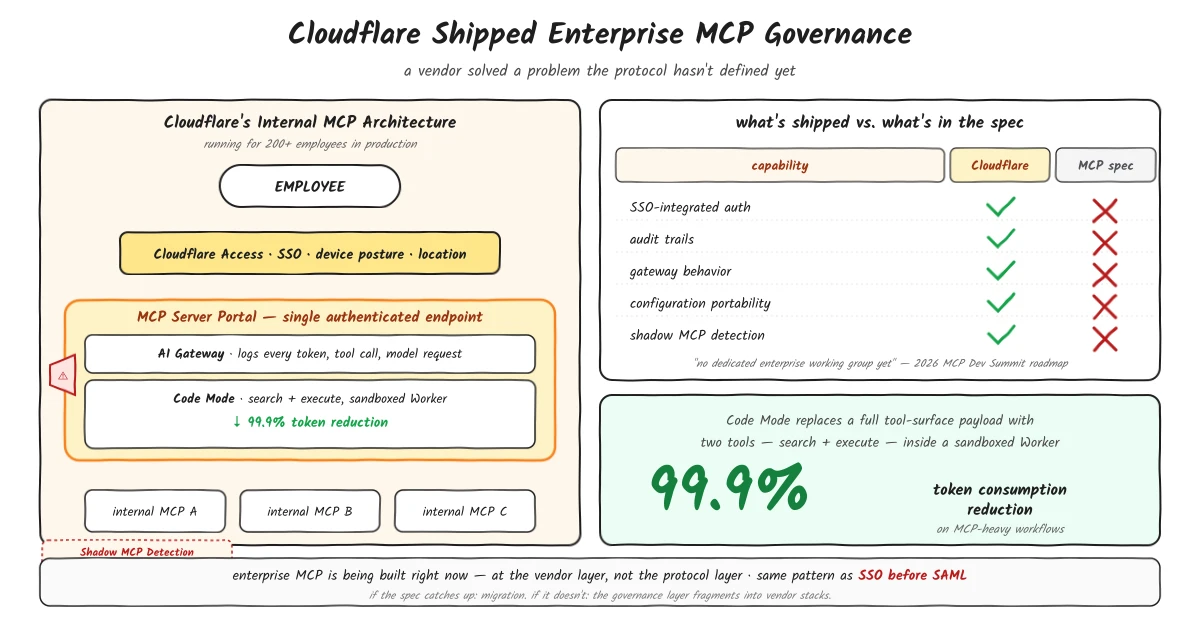
In April 2026, Cloudflare published its internal MCP security architecture and shipped the tooling alongside it: MCP server portals, Code Mode, shadow MCP detection, and AI Gateway integration. This was not a roadmap post. It was documentation of something Cloudflare already runs internally to govern 200+ employees using MCP in production.
The more important detail sits one layer up. The MCP protocol has no dedicated enterprise working group. The features Cloudflare shipped - SSO-integrated auth, audit trails, gateway behavior, configuration portability - are all listed as open gaps in the official 2026 MCP Dev Summit roadmap from Anthropic, AWS, Microsoft, and OpenAI. A vendor solved a problem the protocol hasn’t defined yet. That gap is where enterprise MCP is being built right now.
What Cloudflare Actually Shipped
The architecture has four parts and they interlock.
MCP server portals aggregate multiple upstream MCP servers behind a single authenticated endpoint. Employees connect to one portal managed by the Cloudflare Access identity layer instead of directly to individual MCP servers. That means every interaction is identity-bound: which user, which MCP server, which tools within that server, which device posture, which location. Policies are applied at the portal level. An employee connecting from an unmanaged device can be blocked or restricted without touching the underlying MCP server configuration at all.
Code Mode collapses a full MCP server’s tool surface into two tools: search and execute. The agent describes what it wants in natural language, Code Mode finds the right tool, executes it inside a sandboxed Cloudflare Worker, and returns the result. The context payload sent to the LLM shrinks from thousands of tokens describing every available tool to a single query. Cloudflare reports a 99.9% reduction in token consumption on MCP-heavy workflows. That is not a marginal cost improvement - it makes MCP economically viable at enterprise scale in a way it was not before.
Shadow MCP detection is now a traffic category in Cloudflare Gateway, the same way adult content or gambling are categories. Network-level filtering catches employees connecting to unauthorized remote MCP servers that IT never approved. Most enterprise AI governance conversations focus on which models employees can use. The actual attack surface is also the tools those models have access to. Shadow MCP is the enterprise equivalent of shadow IT, and it arrived faster than most security teams noticed.
AI Gateway sits between MCP clients and the model providers. Every token consumed, every tool call made, every model request fired goes through a choke point that logs it, rate-limits it, and can enforce policy on it. Cost control and security observability from the same layer.
How Cloudflare Runs This Internally
The internal deployment story is more useful than the product announcement.
Cloudflare did not allow individual teams to stand up MCP servers however they wanted and try to govern the result. The centralized platform team built a shared MCP server template inside the monorepo. When an employee wants to expose an internal resource via MCP, they get approval from the AI governance team first. Then they copy the template, write tool definitions, and deploy. Audit logging, default-deny write controls, secrets management, and CI/CD pipelines are inherited automatically. The governance is baked into the scaffolding, not enforced afterward.
The consequence: standing up a new governed MCP server takes minutes, not days. Adoption spread fast because the path of least resistance was also the compliant path. That is a different model from most enterprise security programs, which make compliance harder than the non-compliant alternative and then are surprised when teams go around them.
The Gap the Protocol Hasn’t Closed
Here is the problem that sits underneath all of this.
The 2026 MCP Dev Summit roadmap - Anthropic, AWS, Microsoft, OpenAI, the core maintainers - explicitly names audit trails, SSO-integrated auth, gateway behavior, and configuration portability as open items. The roadmap document concedes there is “no dedicated enterprise working group yet.”
Cloudflare shipped all four of those features using Cloudflare’s own products. That is not a criticism - it is the only reasonable move when the protocol hasn’t defined the standard. But it creates a structural problem: enterprise MCP governance is currently a set of vendor extensions running on top of a transport protocol that was not designed for enterprise deployment.
If the MCP spec ships a governance layer in H2 2026, teams building on Cloudflare’s architecture today have a migration decision to make. If it doesn’t, the enterprise layer fragments permanently into vendor implementations
- Cloudflare’s version, AWS’s version, Azure’s version - that are interoperable at the protocol level and incompatible at the governance level. That is exactly what happened to enterprise SSO in the early 2010s before SAML became the standard everyone grudgingly adopted. The same consolidation pressure is building here. The question is whether it resolves at the protocol layer or gets locked into vendor stacks.
Why This Matters for Anyone Building With MCP
If you are building an MCP server today and you expect enterprises to use it, you are building against a governance specification that does not exist yet. Cloudflare’s reference architecture is the closest thing to a de facto standard available right now. It is worth reading as a design input, not because Cloudflare will be everyone’s infrastructure but because the patterns - identity- bound tool access, default-deny writes, audit logging at the gateway layer, shadow server detection - are the patterns the eventual spec will encode.
The builders who understand those patterns now will have shorter migration paths when the protocol catches up. The builders who ship MCP servers with no auth, no tool-level scoping, and no audit surface will face a retrofit when enterprise customers or the spec require it.
For security people: the shadow MCP category in Gateway is the part worth watching. Enterprise security programs have been slow to recognize that AI agents connecting to unauthorized MCP servers are a threat model. A researcher publishing an MCP server that exfiltrates data through tool call responses is not a theoretical risk. It is a documented attack vector. Gateway-level detection is one layer of the defense. It is not sufficient on its own - application-layer controls catch what network filtering cannot - but most organizations do not have either layer in place yet.
The infrastructure for safe enterprise MCP deployment exists now. It is vendor-specific, it is ahead of the protocol, and the organizations that implement it before being required to will be the ones not scrambling when the standard arrives.
Sources:
- Scaling MCP Adoption: Cloudflare’s Reference Architecture, Cloudflare Blog
- MCP Governance, Cloudflare Agents Docs
- MCP Server Portals, Cloudflare One Docs
- Cloudflare Outlines MCP Architecture as Enterprises Confront Security Risks, InfoQ
- Cloudflare Agents Week 2026 Analysis, wal.sh
- Enterprise MCP Reference Architecture for Secure Agentic Workflows, al-ice.ai
Written by Nirav Joshi · Full-stack & AI Developer
Newsletter
Want the next post like this?
Subscribe for occasional emails when I publish something worth your time.