Reverse Engineering Just Got a Natural Language Interface
A 180-tool MCP server bridges Cheat Engine to any AI agent. Process memory, pointer chains, vtable lookups, code injection - all through plain English. The capability gap Mythos implied is already here, open source.
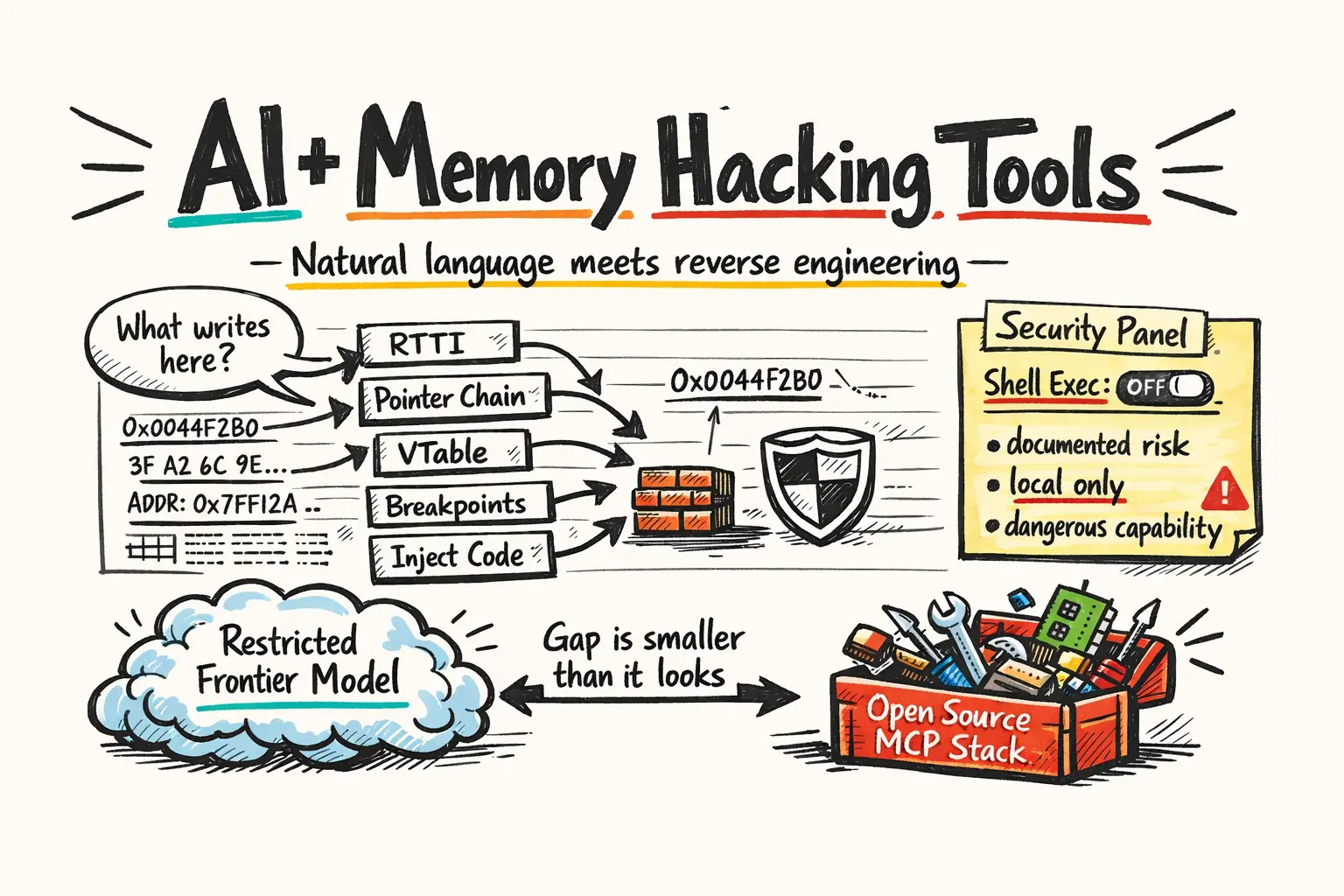
RTTI resolution, pointer chain following, C++ object identification, all happening in response to a plain English question.
Why This Matters Beyond Game Modding
The README positions this for game mods, trainers, and security audits. Those are the obvious use cases. The deeper implication is different.
Reverse engineering has always had a steep entry cost. The knowledge required to navigate a hex dump, follow a pointer chain, identify a C++ object from its vtable, and trace what writes to a memory address took years to accumulate. That expertise gate is now much thinner.
An AI agent with access to these tools doesn’t need to know x86 disassembly by memory. It needs to know which tool to call and how to interpret the output. The reasoning layer is the model. The execution layer is the MCP server. Anyone who can ask clear questions can now do what used to require deep systems programming experience.
That’s not a small change. Security researchers use these same techniques for vulnerability analysis and malware reverse engineering. The tools have existed for years. The natural language interface on top of them is new.
The Security Layer Worth Understanding
The project handles the obvious risk honestly. Shell execution is
disabled by default behind an environment variable (CE_MCP_ALLOW_SHELL),
explicitly flagged as an arbitrary code execution risk in the
documentation. The author didn’t bury it.
But it connects directly to the MCP security story from this week. Anthropic said MCP command execution is “expected behavior” and sanitization is the developer’s responsibility. This project is what responsible implementation of that principle looks like: dangerous capabilities exist, they’re documented, they’re off by default, and the user makes an informed choice to enable them.
Most MCP servers in the wild are not this careful. The 4,584 server trust score analysis from this week had an average score of 53.9 out of 100. The gap between this project and the average server in the registry is documentation, defaults, and intent.
What This Signals
The Mythos discussion this week centered on a model capable of autonomous zero-day discovery, so powerful that Anthropic restricted access and warned about unprecedented cybersecurity risk.
This project is a different data point. It’s not a frontier model. It’s a 180-tool MCP server, open source, running locally, that lets any AI agent with API access read process memory, follow pointer chains, identify C++ objects, set invisible hardware breakpoints, and inject code into any running process.
The capability gap between “restricted frontier model” and “what a developer can assemble from open source tools this weekend” is smaller than the Mythos coverage implies. The natural language layer on top of systems-level tooling is already here. It doesn’t require Anthropic’s approval or a government memo.
The people who understand that are already building with it.
Source: cheatengine-mcp-bridge on GitHub
Written by Nirav Joshi · Full-stack & AI Developer
Newsletter
Want the next post like this?
Subscribe for occasional emails when I publish something worth your time.